Jana Eid explores how the Indian diaspora brought caste discrimination to the U.S. and highlights…
Little Ambedkars: The Radical Legacy of Dalit Conversions in India
Drawing on Abdul Malik Mujahid’s framework of “Little Ambedkars,” author Jana Eid examines how Dalits use religious conversion and interfaith solidarity as strategic acts of protest to break free from systemic caste oppression.
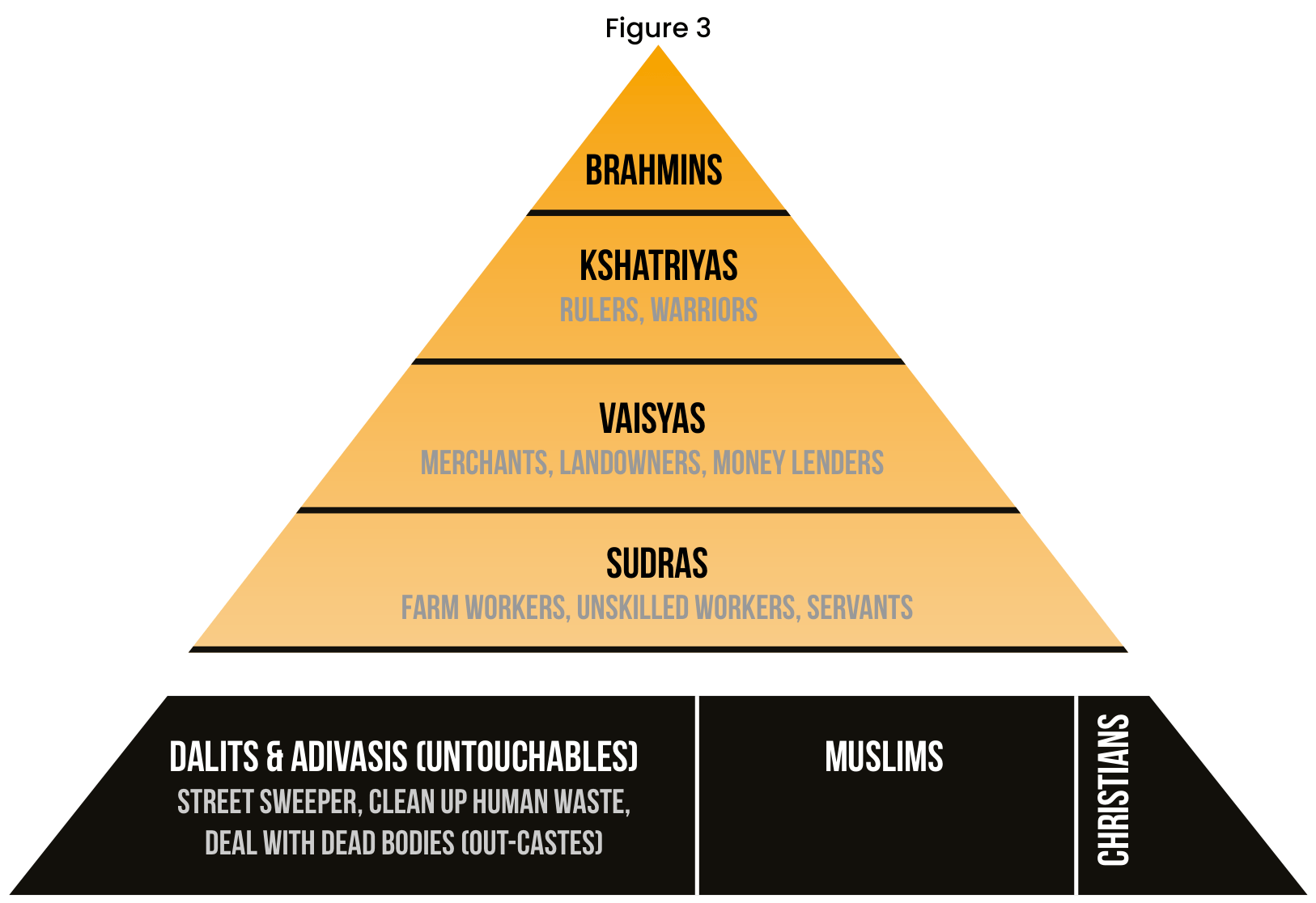
The architect of India’s social movement against caste oppression, Bhimrao Ramji Ambedkar, grew up as a Dalit in the early twentieth century. He understood exactly what it meant to be considered an untouchable in the eyes of upper-caste Hindus because he endured daily acts of discrimination on account of his identity. As a schoolboy, he was forced to sit silently on a piece of burlap at the back of his classroom, and his notebooks could not be touched by anyone, including his teacher. He was strictly prevented from making any physical contact with the drinking water that his classmates used; if he was thirsty, the water had to be poured into his hands. If he dared to accidentally touch a caste Hindu, he would be severely punished through beatings. Despite these daily reminders of his subjugated existence, Ambedkar was determined to climb the social ranks and transcend the limitations of his identity.
He went on to graduate from high school in 1907 as only the second untouchable to do so, before achieving remarkable accomplishments in his career, earning postgraduate degrees from Columbia University in New York and the University of London. Later, he returned to his homeland to cement his role in Indian society as a government worker, newspaper editor, college professor, law school dean, and elected official. When India gained its independence in 1947, Ambedkar was appointed chairman of the Drafting Committee, tasked with writing the new constitution. Yet, after facing eviction threats and death threats, it became increasingly apparent that none of his individual triumphs could extricate him from his caste-based affliction.
In reckoning with the unequal and exploitative social order within Hinduism, Dr. Ambedkar initially sought to pursue reform inside the Hindu social structure. He led a massive nonviolent demonstration for access to the public water supply at Mahad (Chowdar Tank), where protesters took power-defying sips from the public tank. However, when they received an aggressive backlash calling to “repurify” the water, Ambedkar took a revolutionary turn in his career, declaring Hinduism to be the root cause of the Dalit struggle. Before a gathering of fifteen thousand onlookers, he burned a copy of the ancient Sanskrit text Manusmriti, which covers Hindu law, ethics, and social duty, and bestows divine authority upon the caste system. It was not until 1935, after a decade of failed protests, that Ambedkar officially declared his intent to leave Hinduism and eventually embrace the Buddhist faith. At the Yeola Depressed Classes Conference, he delivered a powerful speech framing religious identity as a choice inherently dependent on individual agency:
“If you want to gain self-respect, change your religion. If you want to create a cooperating society, change your religion. If you want power, change your religion.
If you want equality, change your religion. If you want independence, change your religion. If you want to make the world in which you live happy, change your religion” (“Bhimrao Ramji Ambedkar and the Great Conversion”).
Abdul Malik Mujahid coined the term “Little Ambedkars” in his award-winning book, Conversion to Islam: Untouchables’ Strategy for Protest in India. He defined them in the context of political and economic modernization as people who “are informed about their rights and are conscious of the plight of their community” (Mujahid 37). These Little Ambedkars are removed from the “era of hero-following” because they assert themselves as independent individuals and masters of their own fates. A modern-day example of this is the leader of the Cockroach Janata Party (CJP), Abhijeet Dipke, who, instead of blindly following Ambedkar’s revolutionary ideals, has used them to carve his own path of reform for young people in India. He was seen carrying a copy of Ambedkar’s book titled My Autobiography upon his arrival at Indira Gandhi International Airport in New Delhi on June 6, 2026. Little Ambedkars, however, are most perceptible within the conversion movements that transpired following Ambedkar’s sociopolitical calls for religious revolt.
Dravidians, who share overlapping genetic roots with Dalits as descendants of the indigenous pre-Aryan populations of South Asia, founded the Dravidian movement, which aimed to fight caste inequality primarily through a critique of Hinduism. Periyar E.V. Ramasamy, the pioneer of Dravidian politics, used the words “superstition” and “exploitation” to describe the Hindu religion, publicly ridiculing Hindu religious texts as immoral. However, the ultimate tactic of resistance against caste discrimination did not stop at criticizing Hinduism; rather, it inspired thousands to convert in what became known as the Great Conversion. Taking place on October 14, 1956, in the central Indian city of Nagpur, the Great Conversion prompted nearly half a million untouchables to travel on foot to participate in the outdoor ceremony and embrace the Buddhist faith. In his aforementioned book, Mujahid reflects on the power of conversion as a social instrument:
“Because of the relative powerlessness of untouchables against clearly identifiable oppressors, conversion, like Gandhi’s satyagraha or Martin Luther King’s nonviolent resistance, provides a technique for the manifestation of discontent” (82-83).
Although Buddhism garnered widespread support among Ambedkar’s followers, it was not the only religion embraced by Dalits. In an interview, Dr. Obed Manwatkar—a Dalit Christian theologian and author who recently released his debut book, A Tale of Two Mahatmas: Mahatma Phule and Mahatma Gandhi—described Dalits as the “foot soldiers of every religion in South Asia,” recalling how his grandfather was drawn to Christianity’s message of equality and justice in the 1930s. In the late nineteenth and early twentieth centuries, India witnessed significant instances of “collective conversions” to Christianity. Islam later became a focal point for new converts, with one of the first major modern mass conversions occurring in a small village in
Meenakshipuram, Tamil Nadu, in 1981. Around 200 Dalit families participated in a collective conversion ceremony where the promise of egalitarianism offered by Islam served as a safeguard against caste oppression. These conversions to major religions like Islam, Christianity, Sikhism, and Buddhism are inherently grounded in ongoing struggles for equality and self-respect. They embody Dalits’ collective desire to undergo an identity transformation from passive subjects to proactive agents of social change.
These conversions can be recognized as a quest to establish an egalitarian society through social action and transformative change. Ambedkar and his followers established a clear distinction between the spiritual motivations behind Dalit conversion and the pursuit of economic or political gain. At the core of these conversions is the objective to secure social acceptance within a casteless society through psychological and spiritual renewal. The Islamic concept of Tawhid is closely aligned with Dravidian ideals of a casteless society because it requires an individual to divest themselves of worldly attachments to human traditions, social hierarchies, and laws, submitting instead to the sole authority of God. Moreover, conversions occurred not only on a collective scale but also on an individual level, where self-determination became a vital motivation for adopting a new faith. As the state relentlessly attempts to suppress them, Dalits continue to usher in a bold era of resistance.
The state has felt threatened by growing conversions out of Hinduism, as they challenge the image of a unified, territorialized religion that underpins nationalist discourse and state governance. The state would prefer Dalits to remain passive subjects living in subservience under state laws that fail to dismantle caste hierarchies. This is evidenced by the fact that affirmative action reservations for Dalit communities exclude Dalit Christians and Muslims from receiving such benefits. Furthermore, individuals holding caste certificates are required to report any change in religious status to their employers. The state has justified this exclusion by claiming that caste-based discrimination is rooted strictly within Hinduism, arguing theoretically that changing one’s religion removes caste-based oppression. Paradoxically, Buddhist and Sikh Dalits remain included in state reservation policies. It is crucial to note that caste practices persist among adherents of all major religions in the Indian subcontinent as a historical and cultural system; therefore, changing one’s religion does not automatically alter how individuals are treated by others—especially those born into higher castes. The state selectively targets Muslims and Christians as part of a broader ideological agenda against perceived “foreign” religions, with Dalits bearing the brunt of this policy.
While caste plagues adherents across every religion in the Indian subcontinent, Dr. Manwatkar maintains that the battle against the caste system remains inherently spiritual, requiring a “spiritual revolution.” Drawing from personal experience and theological study, he emphasizes that “we need to invent progressive interpretations in light of the scriptures.” He argues that direct study and application of sacred texts, combined with interfaith dialogue and prayer, can counter the divisive trends of a sociocultural practice that has spread globally, including to North
America. No single religion can bridge lines of religious, ethnic, and socioeconomic division in isolation. Pointing to his hometown of Nagpur—a hub for diverse religious centers—Dr. Manwatkar views it as a striking example of how interfaith solidarity can resist the pressures of popular hatred and societal conformity.
Ultimately, the phenomenon of “Little Ambedkars” demonstrates that true emancipation requires reclaiming personal agency and dismantling systemic hierarchies from within and across religious lines. To truly fulfill Ambedkar’s vision of social justice, policymakers and civil society must expand affirmative action protections to all marginalized groups regardless of faith, while religious communities must actively dismantle caste bias within their own practices through scriptural reinterpretation and interfaith solidarity.

Related Posts