Zafarul-Islam Khan (born 1948) is an Indian scholar, author and journalist based in New Delhi.…
From India to America: How Caste Discrimination Followed the Diaspora
SUMMARY: Jana Eid explores how the Indian diaspora brought caste discrimination to the United States and highlights the growing legal and social movement to outlaw it.
Caste and caste discrimination are no longer limited to India. The system has followed the Indian diaspora across the globe, including to the United States. Today, Indian Americans represent one of the largest and fastest-growing immigrant communities in the country; in 2022, the U.S. Census Bureau recorded more than 6.5 million people of South Asian descent residing in the U.S. Many Dalits who moved to America to escape persecution found that the very system that caused them to leave was also embedded within various domestic institutions, primarily the workforce. Equality Labs, a South Asian civil rights organization, released a report in 2018 titled Caste in the United States, revealing that 67% of Dalit respondents felt they were treated unfairly at an American workplace due to their caste. Approximately 12,000 Dalits responded to the survey, with 41% stating they experienced discrimination in education and 25% reporting they had been physically assaulted in the U.S. because of their caste. While respondents hailed from an extensive range of fields, the tech industry has garnered the most public outcry.
Major technology employers, including Cisco Systems, Inc. in Silicon Valley and Google, have come under scrutiny for enabling discrimination by higher-caste employees who predominantly occupy senior-level, higher-paying positions. In July 2020, the California Civil Rights Department filed a lawsuit against Cisco and two of its managers for discriminating against an engineer on the basis of his Dalit identity, denying him both a raise and promotional opportunities. The engineer worked on a team composed entirely of higher-caste employees who had immigrated to the U.S. from India. The Washington Post reported that after the Cisco lawsuit was announced, Equality Labs received roughly 260 complaints from workers in the tech industry concerning caste bias.
The executive director of Equality Labs, Thenmozhi Soundararajan, told The Washington Post that complaints detailed “caste-based slurs and jokes, bullying, discriminatory hiring practices, bias in peer reviews, and sexual harassment.” A member of Google’s Alphabet Workers Union (AWU), speaking under a pseudonym due to fear of workplace retaliation, noted that “companies like Alphabet employ a large number of workers of South Asian origin … via contracting, which strongly intersects with caste” (“In These Times: Meet the Activist Coalition That Outlawed Caste Discrimination in Seattle”). She highlighted how lower-caste individuals are particularly vulnerable to losing their immigration status (as many are on work visas) and to being doxxed or harassed online. AWU is urging Google to add an explicit ban on caste discrimination to its U.S. code of conduct, matching its policy in India, given that there are currently no U.S. federal employment laws that explicitly ban caste discrimination.
To date, several jurisdictions and institutions have succeeded in banning caste discrimination, including the Seattle City Council and various universities. In February 2023, Seattle became the first American city to explicitly outlaw caste discrimination. The Seattle City Council voted 6,1 to approve an ordinance adding caste to its municipal anti-discrimination laws, officially banning caste-related discrimination and harassment in employment, public accommodations, and housing. Several years prior, in November 2019, Brandeis University updated its non-discrimination policy to include caste, becoming the first higher education institution to do so. A number of universities followed suit over the next several years, including Colby College, California State University, Brown University, and Rutgers University.
Different arguments have been made in favor of addressing caste under existing protected class categories. The New Jersey State Bar Foundation defines a protected class as “a person or group of people who are legally protected from discrimination or harm if they possess certain characteristics.” In terms of caste, the most notable established categories are religion and race. California’s Civil Rights Department has argued that the Hindu caste system falls under the protected class of religion. However, this argument rests on the false premise that caste is practiced exclusively by Hindus; in reality, caste cuts across religious boundaries and is frequently observed among Christians, Muslims, and Sikhs as a deeply ingrained sociocultural practice. While caste is historically rooted in the Hindu varna framework, it cannot be comprehensively regulated through religion alone because of its persistent presence across multiple religious communities.
The case for interpreting caste discrimination as a form of racial discrimination involves a rich historical precedent, intersecting with the fight against anti-Black racism in the United States. The caste-race analogy has been drawn repeatedly throughout American history because caste is fundamentally a hierarchical system of social stratification. The Chambers Etymological Dictionary of the English Language (1872) defined caste as “a breed or race; one of the classes into which society in India is divided; a tribe or class of society.” To demonstrate that slavery and segregation ran counter to the core principles of American democracy, abolitionists such as Thomas Dalton, Frederick Douglass, William Lloyd Garrison, and Harriet Beecher Stowe routinely equated the treatment of Black Americans to the caste system of South Asia. The author of an 1833 article in The Abolitionist asserted that members of “the African race are essentially a degraded caste, of inferior rank and condition in society.” Charles Sumner, an American lawyer and U.S. senator, drew a similar comparison:
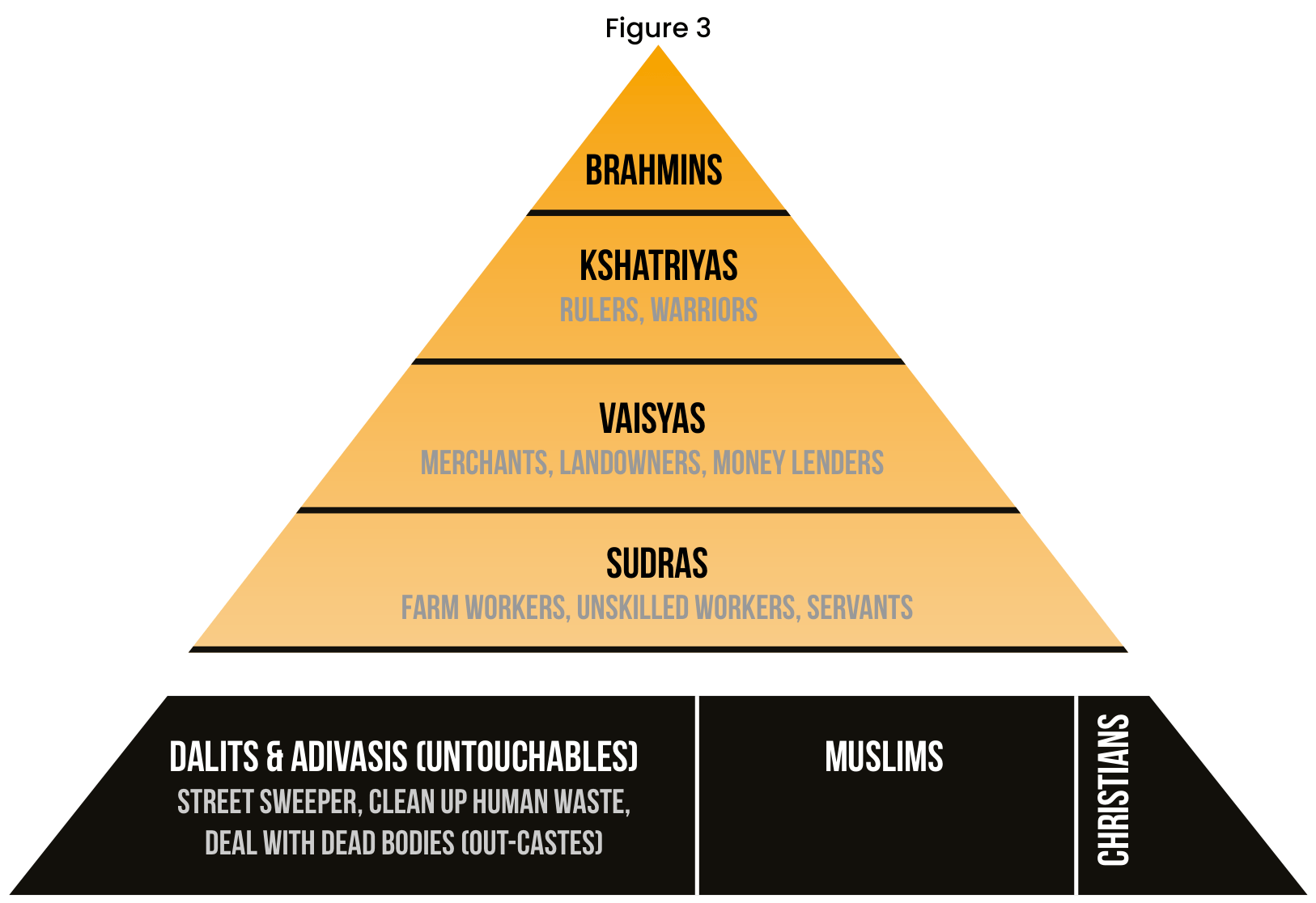
“In India, Brahmins and Sudras, from generation to generation, were kept apart. If a Sudra presumed to sit upon a Brahmin’s carpet his punishment was banishment. With similar inhumanity here, the black child, who goes to sit on the same benches with the white child, is banished, not from the country, but from the school. In both cases it is the triumph of Caste. But the offense is greater with us, because, unlike the Hindoos, we acknowledge that men are born equal” (Brown and Thorat 956).
Furthermore, in August 1866, the Republican Party circulated bulletins clarifying that the Fourteenth Amendment, which guarantees U.S. citizenship to everyone born in the country, was created in part to prohibit caste, and class-based discrimination. While the historical connection between race and caste is substantial, an important legal nuance impacts how caste discrimination fits within race as a protected class.
The Aryan Invasion Theory historical model posits that a group of Indo-Aryan migrants entered northern India while indigenous populations remained in the south, leading to historical stratification where upper-caste groups aligned with the former and lower-caste groups/Dalits with the latter. Under this view, caste aligns with race primarily through ancestry. Reconstruction-Era civil rights laws define racial discrimination as targeting “identifiable classes of persons . . . solely because of their ancestry or ethnic characteristics.” Therefore, to establish racial discrimination based on caste membership, “the victim of caste discrimination must be subjected to intentional discrimination because of their ancestry” (Brown and Thorat 925). This legal requirement makes it difficult to rely solely on race as a protected category, as caste discrimination does not always turn on traceable ancestral traits, but rather targets Dalit identity for its social stigmas and perceived hierarchy.
Despite instances where the caste-race analogy holds, it does not fully encompass Dalit calls for explicit legal protections. Guha Krishnamurthi, a law professor at the University of Maryland Francis King Carey School of Law, explained in a University of Chicago Law Review article why caste is not easily subsumed under existing legal frameworks: “[C]aste is a complex that does involve, inter alia, ancestral and endogamous relations, historic occupation, religious background, and native language. These facts may obfuscate its fit within recognized categories of antidiscrimination law” (Krishnamurthi 2023). Consequently, legal scholars propose that caste be designated as its own distinct protected class, arguing that doing so does not denigrate Hinduism as a faith. Referencing religious history to contextualize and remedy caste-based discrimination is constitutionally permissible under the Establishment and Free Exercise Clauses of the First Amendment. Although agencies like California’s Civil Rights Department and the City of Seattle faced political pushback for citing Hindu social hierarchies when enacting bans, U.S. legal precedent demonstrates that citing religious background in anti-discrimination law poses no constitutional bar. For example, Bob Jones University v. United States (1983) established that anti-discrimination regulations prohibiting practices based on religious beliefs (such as opposition to racial intermixing) do not violate the Establishment Clause. The state’s compelling interest in eradicating discrimination overrides claims of free religious exercise. Furthermore, religious exercise claims are largely irrelevant here, as opponents of caste bans generally maintain that they do not intend to practice caste discrimination in the first place.
In March 2023, legislation was introduced by California State Senator Aisha Wahab to add caste as an explicit protected category under California’s anti-discrimination laws (SB 403). Despite passing by a wide margin in both the State Assembly and Senate, California Governor Gavin Newsom vetoed the bill in October 2023, claiming that existing state anti-discrimination laws were already sufficient to protect individuals from caste-based bias. While the extent of influence exerted by Hindutva interest groups, which advocate a Hindu nationalist framework, remains a topic of debate, their presence in U.S. public discourse and state legislative politics has grown significantly. Governor Newsom’s veto stands in sharp contrast to the lived realities of many Dalits, who view caste as distinct from race and religion, maintaining that it requires explicit statutory prohibition in its own right.
Ultimately, as the Indian diaspora expands across the United States, addressing caste discrimination can no longer be deferred or subsumed under existing legal proxies. Establishing caste as an explicit protected category is an essential step toward ensuring that civil rights protections evolve alongside the nation’s changing demographic reality.

Related Posts