Zafarul-Islam Khan (born 1948) is an Indian scholar, author and journalist based in New Delhi.…
India’s Sanctioned Apartheid
India’s Sanctioned Apartheid
(Jana Eid: 2026-08-13)
SUMMARY: India’s millions of Dalits live in gruelling conditions of both unofficial and increasingly unofficial discrimination and subservience under a regime comparable to apartheid.
“On one side of the road was (our community) settlement and on the other side were huge pucca houses (solid, built with durable materials) where high caste people used to live, who were employed in ‘good’ jobs (well paid, respectful, and secured). Within (our) colony (the dwellers) were mostly untouchables, illiterate and labor. On one side of the road were the poor, illiterate, and on the other side of the road were the rich (and) educated. Only one road divided them but it was a land-sky (like) difference among these two (sections)” — Kaushalya Baisantri. This sounds like an anecdote from Apartheid South Africa, but it actually represents the current experiences of 200 million people in India (16.6% of the total population).
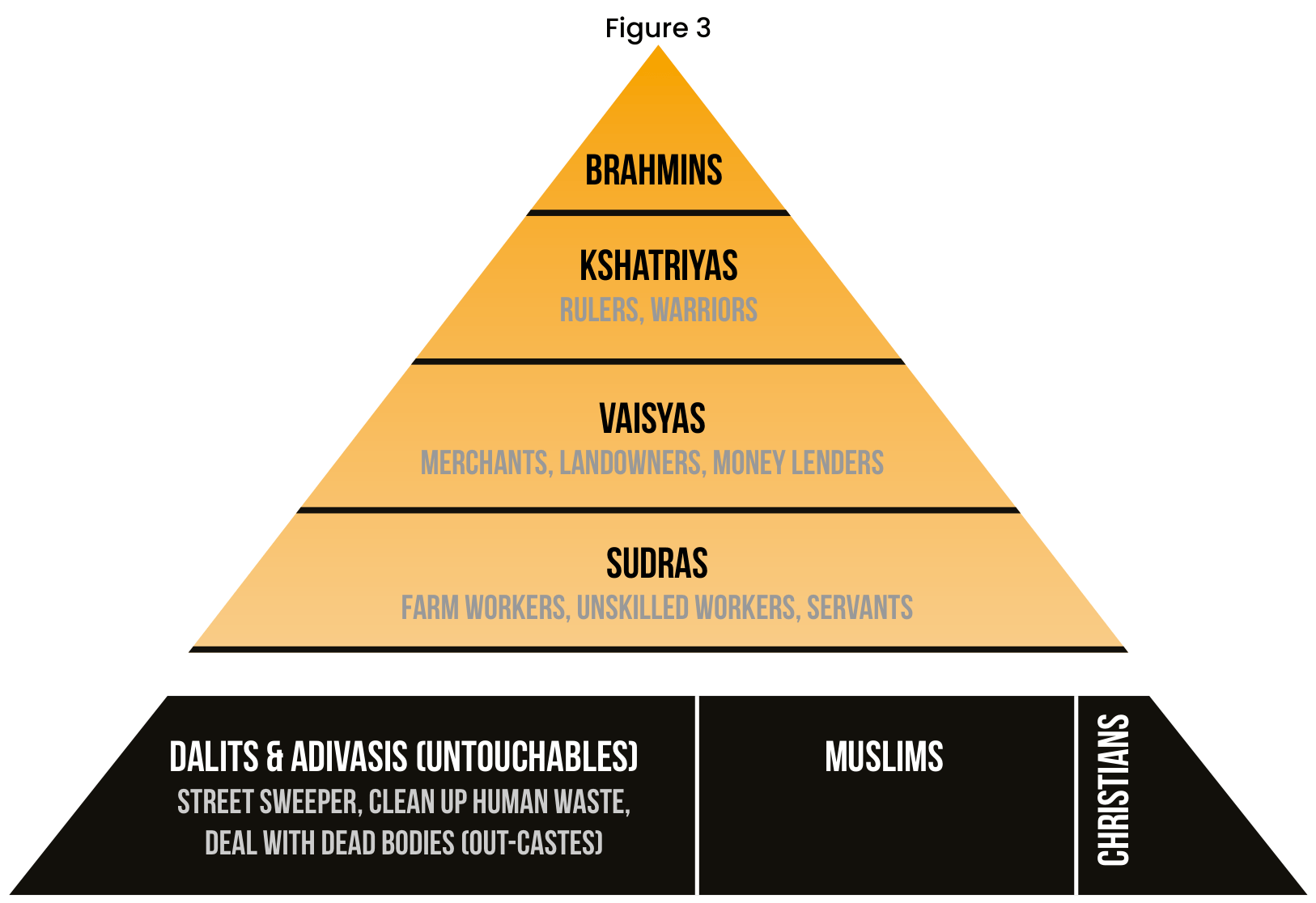
Dalits, who are also known as untouchables or outcastes, are socially excluded from the caste system in India and have been subjected to dehumanizing treatment for several millenia. Despite withstanding conditions synonymous with those of various oppressed peoples in historical contexts, their subjugation has continued without evoking prominent global outrage. The historical, religious, and social importance of caste in India’s society has warranted anyone who exists outside of this structure to be a plague on society. Consequently, Dalits are regularly referred to as untouchables who embody a permanent and hereditary “impurity.” Their untouchability forbids them from touching anyone in a higher caste so much so that even if their shadow (approximately 6 feet) touches caste members, the higher-caste members must do purification rituals to decontaminate themselves. For this reason, Dalits are pushed to the margins of villages and towns where they dwell in hamlets, barred from accessing the same spaces as upper caste members, including housing, temples, schools, and public services.
Due to caste being religiously sanctioned by Hinduism where the concepts of karma (deeds) and rebirth have immutable consequences, Dalits are guaranteed that they have no way of changing their present caste by effort or deed in this life. One’s present birth is determined by the deeds committed in their past birth and their future birth by their present deeds, so while one can change their fate by being assigned to a higher caste after rebirth, they must accept their current predicament. Dalits are chained to the following menial tasks which are deemed too “polluting” for non-Dalits to carry out: manual scavenging, cleaning streets, removing trash and bodies, cleaning toilets, maintaining sewage systems that tend to involve substantial manual labor, collecting cow manure and turning it into cooking fuel, slaughtering animals, digging wells for water, and performing agricultural labor as landless peasants. They are also strategically denied access to land, so upper-caste farmers can lay claim to it. The former U.N. High Commissioner for Human Rights summarized the treatment of Dalits by stating that the caste system condemns many individuals and communities “to a life of exploitation, violence, social exclusion and segregation,” and it “is the very negation of the human rights principles of equality and non-discrimination” (Brown and Thorat 929-930).
Dalit women’s oppression deserves the utmost attention as it is uniquely positioned at the juncture of gender bias, caste discrimination, and class deprivation. The term Harijans, which is used in some spaces to refer to Dalits as a whole, more specifically refers to female Dalit victims of rape. This is because they are regularly subjected to sexual violence that includes rape, physical and sexual harassment, forced prostitution, kidnapping, and domestic violence. Human Rights Watch published a report highlighting that more than four Dalit women are raped every day. In a study of 210 respondents from Delhi and outside Delhi featuring the exploration of caste, class, and gender in terms of sexual violence, it was found that caste happens to be the largest indicator of sexual violence or sexual assault and gender heavily influences caste and class at once.
An incident in Uttar Pradesh in October 2020 revealed that a Dalit woman was gang raped by four higher caste men. Two weeks later, she died in a hospital in Delhi. Two women’s rights organizations that examined rape cases from 2009 to 2020 found that 80% of the sexual violence cases against Dalit women and girls were committed by upper caste dominant men. Rape is systemically performed by landlords and agriculture field agents against rural Dalit women and even by the men in their families. Therefore, Dalit women are primarily vulnerable to sexual violence due to something as simple but as significant as their caste. Options for redressal are limited because of fear of social exclusion and threat to personal safety as well as difficulties understanding complicated legal proceedings. In Punjab on January 5, 2006, Dalit laborer and activist Bant Singh seeked the prosecution of the people who gang-raped his daughter and was beaten so severely that both arms and one leg had to be amputated. An estimated ninety percent of crimes against Dalit women go unreported to the police.
Targeted protections for Dalits have been developed throughout India’s post-colonial period. British policy and the demands made by Dalit communities and other minorities in India led to the development of a system of communal representation that granted preferences and quotas to lower castes in the 1920s. The plight of Dalits could only be understood by the whole nation amidst the backdrop of British rule and the unfair treatment of Indians. Mohandas Gandhi, a renowned anti-colonial nationalist and peace activist, urged Hindus to learn ‘equality’ themselves before demanding it from the British. Favored treatment towards lower castes in areas of education, employment, and even political expression in legislative bodies was manifested through Article 17 of India’s Constitution (1950): “Untouchability is abolished and its practice in any form is forbidden. The enforcement of any disability arising out of Untouchability shall be an offence punishable in accordance with law.” And in India’s first Parliament (1951), 74 out of 481 seats were reserved for Dalits and lower castes.
Although these measures are ostensibly progressive and combat caste discrimination, they do not actually abolish the institution of caste. Instead, they work to consolidate caste even further as Dalits and lower castes believe the quota system is their best chance at achieving any equality. The European Parliament passed a resolution in 2007 indicating India’s efforts to enforce laws protecting Dalits as “grossly inadequate,” adding that “atrocities, untouchability, illiteracy, [and] inequality of opportunity, continue to blight the lives of India’s Dalits.”
Dalits have persisted in their struggle for equal access to basic rights including those of others as evident by the recent protests staged by the Cockroach Janata Party (CJP). The protests have focused on demanding education reform and equal opportunity for the youth of India in the midst of examination irregularities and extremely high unemployment rates. The leader of the CJP, Abhijeet Dipke, is both a Dalit and graduate of Boston University, who decided to start the movement on social media with the question “What if all cockroaches came together?” The reference to “cockroaches” emerged from a comment the Chief Justice of India’s Supreme Court made comparing young people to “cockroaches” and “parasites.” Until now, the CJP protests have incited 20,000 people, mostly students and young people, to take to the city’s streets, serving as an opening for the country’s opposition party to announce its support for the CJP efforts and denounce the economic inequalities that the government has brought about.

Related Posts