
Caste Through A Hindu-based Lens
(Jana Eid: 2026-07-27)
Caste can be found in every major institution and segment of India’s social sphere, especially its political arena. Just in 2024, there was a major divide between India’s Bharatiya Janata Party (BJP) that is led by India’s prime minister, Narendra Modi, and the Indian National Developmental Inclusive Alliance (INDIA) over caste discrimination. Mr. Modi promoted a campaign that championed economic growth and “development for all” whereas the INDIA Coalition led the pursuit of a national census for all castes and an expansion of quotas, criticizing upper-caste dominance throughout the campaign trail. They even argued that Mr. Modi’s alliance would discard quotas from the constitution – a series of affirmative action policies for historically marginalized and disadvantaged caste groups. This ultimately led to lower-caste voters turning away from BJP and Hindu-nationalist leaders as the BJP only won 33 of the 80 seats that India’s most populous state, Uttar Pradesh, maintains in the lower house. Evidently, caste still has the power to reshape crucial political lines, but many outside of India are unaware of its origins in a 3000-year old Hindu framework known as Varna.
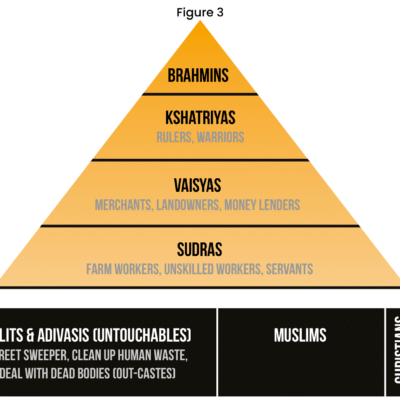
While this framework is different from caste in foundational ways, it is also a seminal structure that caste is modeled from. The caste system is divided into the following four rungs from the highest to lowest status: Brahmins (priests or religious leaders and academics), Kshatriyas (rulers, administrators, and warriors), Vaishyas (artisans, tradesmen, farmers or merchants), and Shudras (manual laborers). Dalits are known to be excluded from this system as they are often referred to as untouchables, outcastes, or scheduled castes. Their subjugation is largely justified and sanctified by this religious hierarchy that is outlined in key ancient Hindu texts such as the RigVeda and Manusmriti. The term Varna literally translates to “color or light” in most passages of the RigVeda, but the word itself comes from the Sanskrit root “Vri,” which means carrying out one’s responsibilities and duties in line with one’s talents and virtues. Although it seems as though the Varna framework holds a high regard for non-hereditary elements that shape an individual’s life path such as temperament, quality, aptitude, and mental state, one’s varna or placement within the social hierarchy is essentially pre-determined.
The origins of Varna can be found in a hymn of the RigVeda, known as Purusha Sukta, which describes a mythical legend of a primeval giant called Purusha or “World Spirit.” A relevant passage from the hymn is translated as: “When (the Gods) divided Purusha, into how many parts did they cut him up? What was his mouth? What arms (had he)? The Brahmana was his mouth: the Rajanya was made his arms; the being (called) the Vaisya, he was his thighs; the Sudra sprang from his feet.” This passage brings to light the hierarchical structure of Varna as the first three castes are identical with the mouth, arms, and thighs of the creator while the Sudra are relegated to the creator’s feet. The higher status of the first three castes is primarily due to the fact that their lineage can be connected to the Aryans who led the conquest of the indigenous inhabitants in the Indian subcontinent. The RigVeda supports this notion of Aryan precedence as it identifies two Varnas known as the Arya and Dasa, where the former represents the Aryans and the latter represents the aboriginal peoples, who after being conquered were treated as slaves and designated as Shudras – the lowest rung of the caste system.
Within the Manusmriti, which provides a credible and authentic explanation of Hindu law and serves as a guide for human evolution and culture, a sharp distinction is made between the three higher classes and the Shudra. The former were twice-born (dvija), once at their natural birth and again at their initiation, when they became a part of Aryan Society. The Sudra, however, had no initiation at all as they were widely held to be non-Aryan. Over time, the term Shudra or Sudra, came to include dasyu-varnu or dark-skinned people who were deliberately excluded from the religious and ritual cult of the Aryans. Manusmriti justifies this exclusion as it indicates that the Sudra’s only duty is to serve the three higher classes. The only hope that Sudras have is rooted in their group’s ability to move up the social hierarchy over a number of generations by adopting more orthodox practices that are closely aligned with those of the Brahmins. Dalits, on the other hand, are completely deprived of any opportunity to change their status or living standards. None of them are even allowed to live in an Aryan town or village, instead being forced to dwell in hamlets that are removed from society as a whole.
Most importantly, the Varna system is supposed to be symbolic of an ideal social organization where lifestyle harmony is maintained and preserved. In other words, the system resembles an attempt to establish a social law that ensures occupation is the organizing principle of a well-ordered society. Kancha Ilaiah, an Indian political theorist and Dalit rights activist, states this clearly when he reflects on the basis of Hindu philosophy in his book Why I am Not a Hindu: “…This morality and immorality is not based on a divine order or divine edict. It is discussed in terms of the harmony of the families” (Ilaiah 5). Varna stratification is built on the premise that occupations are hereditary because function and aptitude are determined by birth. Therefore, the practice of endogamy was not founded to demarcate the Aryan and the non-Aryan, but to draw distinct boundaries between occupations of varying status. D.D. Kosambi, an Indian mathematician, puts it into concise terms: “Caste is class at the primitive level of production” (Jaiswal 44). The people exploited in this system, notably Dalits, have also learned to internalize this entrenched form of stratification, accepting that their occupational and social status is fixed from birth.
As a result, caste identity has become a greater marker of social well being. While the capitalist mode of production has alleviated some caste grievances and reduced the notion of a hierarchy to a certain extent, it has also bolstered contractual and impersonal relationships between castes. In times of adversity, dependence on the members of one’s own class to provide group-support has increased. Because cultural individuality in Hindu society has received its importance from this hierarchical class structure, we are left with the realization that Hinduism has become dangerously interconnected with the institution of caste. There is no hope of this relationship being weakened as long as people employ Hindu philosophy and culture to vindicate class superiority and caste division.
========================================
